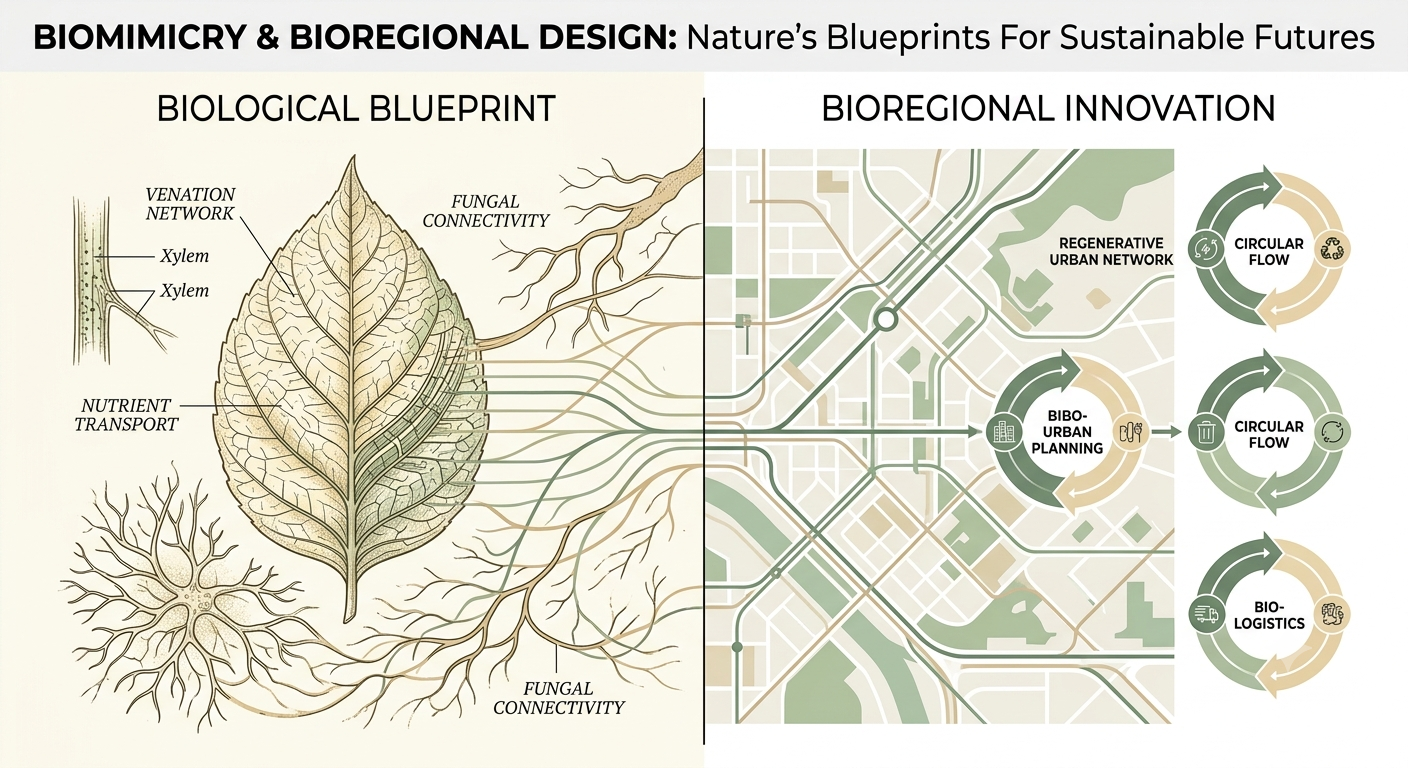
Nature’s Blueprint: How Biomimicry Reimagines Regional Resilience
Reading Time: 3 mins
When human organizations face a crisis—whether economic, operational, or logistical—we usually look to our competitors or historical data for answers. However, the most successful, resilient, and adaptive systems on Earth never read a management textbook. They don’t use fossil fuels, they produce zero waste, and they have been optimizing their supply chains for 3.8 billion years. They are called ecosystems. To build communities and businesses that can survive the Anthropocene, we must stop learning about nature and start learning from nature.
What is Bioregional Design?
At the Institute for Eco-Creative Dynamics (IDEC), we don’t look at biomimicry as just a tool for engineering better physical products. We apply it at a macro scale: Bioregional and Organizational Design.
A bioregion is a geographic area defined not by political borders, but by natural boundaries—its watersheds, soil types, and native flora and fauna. By looking at a city, a company, or a local territory through a bioregional lens, we ask a fundamental question: How would nature run this organization?
- 🍃Closed-Loop Resource Circulation: In a forest, the waste of one organism is the literal currency of another. Bioregional business models map local industrial flows to ensure waste becomes a nutrient for nearby processes.
- 🍃Decentralized Interdependence: Natural networks (like fungal mycelium) are radically decentralized yet deeply interconnected, sharing critical resources in real-time based on local stress points.
- 🍃Cooperation Over Extraction: While competition exists, long-term ecosystem survival is entirely achieved through mutualism and shared symbiosis.
From Concept to Terrain: Le Jardin du Roc..K
We don’t just theorize these frameworks; we test them live at our pilot learning hub, Le Jardin du Roc..K, located in Brittany, France. Here, we observe how local living systems self-regulate, build soil health, and capture water naturally.
We then translate these biological strategies into actionable tools for elected officials, regional planners, and entrepreneurs. By understanding the unique ecological genius of a specific territory, we can co-create economic models that protect biodiversity while strengthening local human communities—moving closer to our ultimate vision of One Health Nations.
« Humankind is currently behaving like an invasive species, exhausting the very life-support systems we depend on. Biomimicry offers a path to becoming a ‘welcome species’ once again—one that actively regenerates its environment. »
Want to co-design with nature?
Join our action-research community or explore our collaborative workshops on biomimetic systems.
No responses yet